
How to Design a Winter Walking Program

With winter fast approaching in Michigan, it’s a great time to start your winter fitness plans! Winter can make it more difficult to stay as active as we’d like, but with a little pre-planning you can continue to prioritize your health all year long.

The CDC recommends 150 minutes of moderate exercise per week for adults, and a consistent walking routine is one of the simplest and most effective ways to stay active at any age. While 150 minutes can be a great long-term goal, some activity is always better than none!
Benefits of walking reach far beyond weight loss/management. Other benefits include reduced risk of disease, lower blood pressure, increased HDL (“good”) cholesterol, improved sleep, a stronger immune system, and improved mental health.
Here are a few tips to consider when designing a winter walking plan:
Set realistic goals.
Setting a goal will depend on your current activity level. If you are already active, setting a goal for a more frequent or more intense walking routine would make sense. But if you aren’t currently active, jumping right in to 150 minutes of walking per week could potentially do more harm than good, and could even cause injury without the right precautions. Start with smaller goals that are challenging, but achievable based on your current activity level.
Decide where to walk.
Exercising in colder weather can improve endurance and help transform white fat (belly and thigh fat) into calorie-burning brown fat. Working out in the cold can even burn 34% more calories as the body works harder to regulate its temperature! If the weather is too severe or you just aren’t comfortable walking outdoors, gyms, local walking clubs, malls, or even just counting laps around the house can be great ways to establish an indoor routine.
Choose the right gear.
If you do walk outside, the right gear is essential for safety. Be sure you have water resistant shoes with good grip. Dressing in layers can help keep you comfortable outdoors – the first layer should be moisture wicking (lightweight), the second layer should be warm and insulating (think a wool or cotton sweatshirt), and the third layer should be wind/water repellent. Unless it’s raining, snowing or very windy, remove the third layer to prevent overheating.
Prioritize stretching.
Though walking is a relatively low-impact workout, stretching is still an important way to warm up and prevent injury and soreness in the days following your walk. Focus stretching on the hamstrings, ankles, calves and groin while incorporating both static (click here for some ideas!) and dynamic stretches, like arm circles and marching in place.
How far/long to walk.
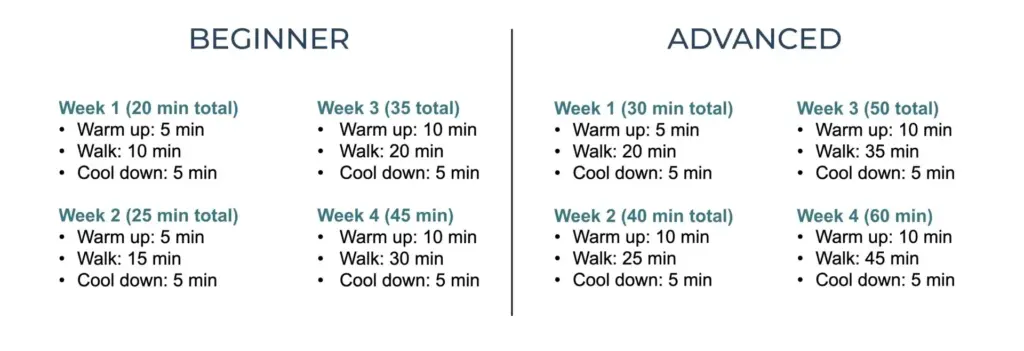
If you’re just getting started, the big question is, “How long do I walk?” At the start of a routine, it’s best to focus on consistency and duration instead of a specific distance to walk. Here are two sample options of 4-week programs to help you set your goals.
Maintain or elevate your program.
Once you establish a solid routine, you can move into maintenance mode and continue with the 4-week programs shown above. If you want to elevate your program and make it more challenge, consider the following:
- Change your terrain to challenge muscles/joints
- Reverse your normal walking route for change of scenery
- Increase pace to increase your distance in the same time frame
- Interval walking (alternate 3-minute intervals of a faster then slower pace)
- Add ankle/hand weights
- Motivate others by inviting friends and family
Track your progress with our free printable!
Tracking is one of the best ways to get an accurate view of your consistency, performance and progress in an exercise routine. Click here to download our walking log printable to track your sessions! There is even a spot on the walking log to record how you feel after each walk, which can help you track what types of walks work best for you.
Many people have nagging aches and pains that make it hard to keep to a consistent exercise routing. If you have pain that is keeping you off track, contact a Renue Physical Therapy clinic near you for a free 15-minute pain screening! Our therapists can make recommendations that will help you may exercise and your health a priority this winter.